
Home  
  Russia  
  Russian  
  Recipes  
  Entertainment  
  Traditional  
  Services  

Health

Required Vaccination for a trip to Russia

There are no additional vaccinations required.  It is recommended to have up-to-date vaccinations for tetanus, diphtheria, poliomyelitis and hepatitis A.
    
Travellers going to Siberia or forested areas of Russia are advised to get vaccines against rabies and tick-borne encephalitis (TBE).
Basic Information for Travellers to Russia

During the past couple of years Russia has been confronted with increasing number of sexual transmitted diseases (also AIDS/HIV). So it is strongly recommended to avoid unprotected sex contact.

Visitors to Russia should obtain a travel health insurance covering medical evacuation. Due to the Reciprocal Health Care Agreement between Russia and the UK, British citizens enjoy free treatment in Russian hospitals.

Most Russians are used to drinking tap water. Tourists are advised using bottled or boiled water only.

Avoid purchasing food from cheap street takeaways and consume only well cooked meat.

Do not forget a first aid kit. Most medicines can be purchased in Russian pharmacies without prescription, though.

Bild: Park in Russland: Zecken lauern in Russland auch in Stadtparks
Vorsicht bei Ausflügen ins Grüne: Zecken kann es in Russland auch in Stadtparks geben

In den letzten Jahren haben sich die Zecken in Russland extrem verbreitet. Zeckenbisse werden fast in allen Regionen der Russischen Föderation registriert. Vor allem bei Reisen nach Sibirien ist Vorsicht geboten. Doch auch in Zentralrussland lauern Zecken nicht nur in den Wäldern, sondern auch in Parks und Grünanlagen der Städte. Bei Reisen nach Moskau ist das Risiko eher niedrig. Wer nach Kaliningrad, St. Petersburg oder Jekaterinburg reist, sollte besser aufpassen.

In einigen Städten wie, zum Beispiel, in Jekaterinburg werden Grünanlagen vorsichtshalber mit speziellen Chemikalien behandelt. Laut offiziellen Schätzungen leben in Russland ca. 3,5 Milliarden Zecken. Deswegen ist es wichtig, bei allen Ausflügen ins Grüne (auch bei Aufenthalten auf einer Datscha!) sich vor Zecken zu schützen.

Die Zeckengefahr besteht in Russland generell von Mai bis August und kann in manchen Regionen sogar bis Oktober / November dauern.
Den besten Zeckenschutz bietet geschlossene Kleidung und Kopfbedeckung. Die Zecken lauern nicht nur auf Bäumen, sondern auch im Gras. Nach einem Picknick am Flussufer oder im Stadtpark, sollte man sich auf jeden Fall auf Zecken absuchen.

Die Zecken in Russland können die FSME, Borreliose sowie andere Krankheiten übertragen. Die FSME gilt als die gefährlichste von Zecken übertragene Krankheit. Experten schätzen allerdings, dass in Russland nur jede hundertste Zecke die FSME-Virus in sich trägt. Mit der Borreliose ist dagegen jede fünfte Zecke infiziert.

Virus: Die FSME (Frühsommer-Meningoencephalitis)
Das FSME-Virus kann das zentrale Nervensystem des Menschen angreifen und zu schweren Lähmungen, Gehirnstörungen und sogar zum Tod führen. Im Jahr 2010 wurden 45% der FSME-Infizierungen in der Russischen Föderation in Sibirien registriert. Zu den besonders gefährlichen Regionen zählen die Landkreise Krasnoyarsk, Tomsk, Barnaul und Perm. Laut der Information des Auswärtigen Amts schützt der in Deutschland erhältliche FSME- Impfstoff auch vor der in der Russischen Föderation endemischen Virusvariante.

Infektion: Die Lyme-Borreliose
Die Borreliose erkennt man an kreisförmigen Hautrötungen, die sich von der Einstichstelle ausbreiten. Die Borrelliose wird mit Antibiotika behandelt.

Avian influenza (Bird Flu) in Russia

Some regions of Russia reported outbreaks of avian influenza (H5N1). That is why it is important to take following precautions:

  • avoid contact with all kinds of birds (and their feather) as well as with other alive or dead animals;
  • ensure that eggs and poultry products are well cooked (the virus dies at temperatures reaching 70C in the middle of the product);
  • keep raw and cooked meat separately;
  • it is prohibited to import birds, eggs and poultry products into the European Union and the USA.

Emergency

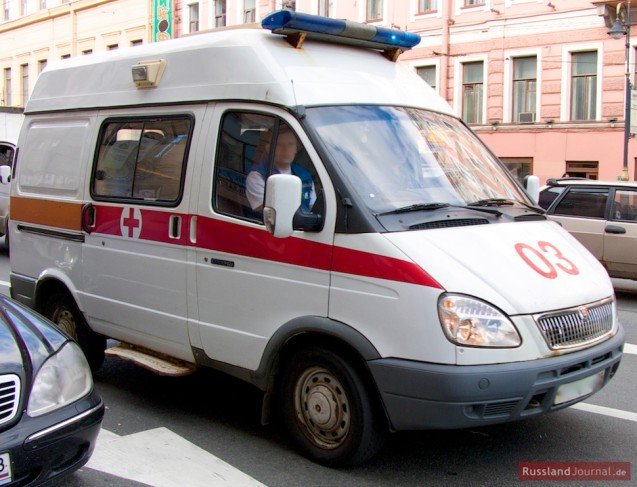
The emergency number for ambulance is 03. To be able to communicate with Russian doctors you will need strong Russian skills.
    
For immediate medical assistance it is also possible to contact the doctor at the hotel or following medical organisations: 

In Moscow:

Citizens Emergency Center of the U.S. Embassy
United States Department of State
Telephone: (202) 647-5225 - 24-hours, everyday

European Medical Center
Spiridonievsky Per. 5, Bld. 1
Metro: Tverskaya
Emergencies 24 hrs: +7 (495) 933 6655

American Clinic
Grokholsky lane, 31, 1st floor
Metro: Prospekt Mira
Tel: +7 (495) 937-5757

International SOS alarm center (for members)
Open 24 hours a day
Tel. +7(495)937 6477

Global Voyager Assistance
Medical Evacuations
Tel: +7(495)775-0999

WHO Office of the Special Representative of the Director-General in Russia
Ostozhenka Street 28
Tel. +7(495)787-2100
Tel. +7(495)787-2101

Ministry of Health and Social Development of the Russian Federation
Rakhmanowskij per. 3
Tel: +7(495)9284754

In St. Petersburg

Euro Med Clinic
Suvorovsky prospect 60
Metro: Ploschad' Vosstania and Chernishevskaya
Tel. +7 (812) 327-03-01

MEDEM International Clinic & Hospital
Marata Uliza 6
Metro: Mayakovskaya
Tel. +7 (812) 336-3333

RusslandJournal.de folgen
BOOK A HOTEL IN RUSSIA
Hotels in different cities and towns of Russia
Check room availability and rates of all major travel websites at the same time. Compare hotel details in one set of search results.
Enter your requierements and get the best hotel deal
Billige Flüge nach Russland buchen
RusslandJournal.de Videos
TRAVEL GUIDES AND BOOKS ABOUT RUSSIA
Putin's Russia: Life in a Failing Democracy by Anna Politkovskaya
The author made her name with her fearless reporting on the war in Chechnya. In this book she turns her steely gaze on the multiple threats to Russian stability, among them President Putin himself. Anna Politkovskaya was shot dead in October 2006 in Moscow
Buy new or used
Russia & Belarus (Lonely Planet)
Russia is as diverse as it is dramatic, while Belarus satisfies those in search of a Soviet experience. Immerse yourself in the rich heritage - from Minsk to Moscow, Siberia to Kamchatka, with this best-selling guide to the most enigmatic destinations.
Buy new or used
Trans-Siberian Railway (Lonely Planet Travel Guide)
The only guidebook you'll need on this epic train journey. Ride the rails through Russia in a week, or take a month to explore Siberian outback towns, learn throat singing in the wild Tuva Republic or meet Mongolian nomads.
Buy new or used
Moscow (Eyewitness Travel Guides)
With beautifully commissioned photographs, and spectacular 3-D aerial views revealing the charm of the Russian capital. Unique cutaways and floor plans of important sights. The survival guide section with lots of useful information.
Buy new or used
St. Petersburg (Eyewitness Travel Guides)
With beautifully commissioned photographs, and spectacular 3-D aerial views revealing the charm of St. Petersburg. Expanded hotel & restaurant listings, better maps, enhanced itineraries, and easy-to-read print!
Buy new or used