
Russian Orthodox Easter
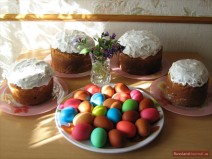
Typical easter table in Russia
Easter (Russian: Пасха [Paskha]) is in Russia the major religious celebration of the year. It is even more important than Christmas. Faithful and atheists, kids and adults, city dwellers and country folk go to church to attend the Easter Mass. Easter in Russia is a lot more than a celebration of the resurrection of Jesus Christ. This is a long and powerful tradition that could not be eliminated even by the communists. Easter cleanses our souls and thoughts. It brings peace, joy and hope. And, of course, the Russians are looking forward to a happy family feast with lots of special Easter food like Easter bread, traditional cheese cake Paskha, Easter eggs and other tasty treats.
In Russia Easter is usually celebrated later than in the West. This happens because Easter dates are determined by different calendars. The Russian Orthodox church uses the old Julian calendar, whereas the Roman Catholic and Protestant churches switched to the Gregorian calendar in the 16th century.
| Russian Orthodox | Catholic | |
| 2026 | 12. April | 5. April |
| 2027 | 2. May | 28. March |
| 2028 | 16. April | 16. April |
Easter in the Russian Orthodox Church
The Russian Orthodox Church celebrates Easter in a special way. Already on a Saturday night people put on their best clothes and come together in dark churches that symbolise a gloomy world without the light of faith. In the past, satanic creatures were believed to turn especially evil in the night before Easter. People didn’t dare to go outside after sunset as they feared every cat could be a witch and every dog a devil. A church was a safe shelter, though.
Russia's Main Easter Service in Moscow
Patriarch Kirill of Moscow and All Russia holds the Main Easter Service at the Cathedral of Christ the Savoir in the centre of Moscow.
At midnight ringing church bells announce the resurrection of Jesus Christ. Priests come to the altar holding a crucifix and candles. Solemnly singing, they walk through the church and then around it. Everyone lights the candles and follow the procession. Churches and cathedrals are now full of singing voices and candle lights.
The Orthodox liturgical chant substitutes a Catholic organ and creates a very special atmosphere. The Mass goes on till dawn. Today, the president and other politicians also attend the Easter Mass.
As there are no bench rows in orthodox churches, some people find it difficult to stand the whole mass that goes on for hours. But the impressive ceremony is worth every effort. The Easter service ends early in the morning when the priests go around the crucifix. Numerous church bells start ringing, the singing gets louder, and finally the priests tell everybody to forgive each other and seal it with a hug and a kiss. Everyone happily follows this appeal. The traditional Easter greeting can be heard everywhere: "Christ is risen!" (Russian: Христос воскресе!) and the answer "He is truly risen!" (Russian: Воистину воскресе!).
Traditional Easter
The holy week is pretty much busy in most Russian homes. Once a spring cleaning is done, it’s time for baking Easter bread. The eggs are painted on Holy ("Clean") Thursday and fresh Easter cakes (Paskha) are prepared on Saturday. It’s a tough time as Saturday is the last fasting day when orthodox Christians are allowed to eat very little. Tasting food while cooking is also forbidden. But everyone is looking forward to the feast, and the cooks do their best. It is a tradition to bless
Easter eggs and bread in the church. Fasting ends after the Easter Mass and feasting begins.
The Easter Day starts with a long family breakfast. The table is decorated with fresh flowers, pussy-willow branches and, of course, painted eggs. Besides Easter bread and Paskha that are only eaten on Easter, there is lots of other food on the table like sausages, bacon, cheese, milk, etc. – so basically everything that was prohibited during the Forty Day Fast. However, the feast starts with a piece of aromatic Easter bread.
Sharing food on Easter has been a long tradition in Russia. That is why after breakfast people visit their friends and neighbours exchanging eggs and small Easter breads. If the first egg you get on Easter is a truly gift given from the heart, it will never go bad, says an old Russian wisdom.
It is also common practice to visit cemeteries and bring eggs, some bread and beer to the graves. In doing so, people let deceased loved ones enjoy the feast.
Strangely enough the weather on the Easter Day is usually very nice and sunny. "The sun plays", say the Russians. It is an old custom to open the cages and let birds go free on Easter.
In the past, only men were allowed to ring church bells. Bell-ringing could be heard everywhere creating a joyful atmosphere. There was no Easter without swinging on a swing. It was great fun, especially for kids and girls. Guys played harmonica watching the girls swing. There was a lot of flirting going on.
It is still very popular to roll Easter eggs on the ground or down a hill. The aim of the game is to break the eggs of other players without damaging your own ones. Experienced players pay special attention to the form of the eggs and even make special gutters for the eggs to have a better roll. Farmers believe that rolling eggs keep the soil fertile.
Beautiful Easter Eggs
Painted eggs are an international Easter symbol. In Russia Easter eggs are believed to possess magic powers. They are supposed to protect crops against hail damage, keep cattle healthy and ward off evil spirits. An Easter egg hidden in the foundation of a house would bring the owners happiness and prosperity. It should even be possible to make yourself look younger by rolling an Easter egg over the face. So it’s no wonder that painted and blessed Easter eggs used to be kept as lucky charms for a long time. One day someone started making and painting wooden eggs. Porcelain, golden, silver and gemstone eggs are very precious. The most exquisite ones are probably the Imperial Easter Eggs designed by the world-famous jeweller Peter Carl Fabergés for the Russian Royal Family.
Traditional Easter eggs are red. Of course, it is also possible to use other colours. In Russia eggs are often cooked together with onion skins or wrapped in colourful fabric remnants. Spinach dyes eggs green and beet root gives them a red tint. Easter eggs get a nice shine if rubbed with vegetable oil.
Find out more about Russian Easter food and learn how to cook and dye Easter Eggs.